May 28, 2021

Australian "Interim" subs? Naval Group Best Bet. Aus Missions?

See the Australian government owned ABC News article dated May 27, 2021.

PETE COMMENT

This ABC article is an Australian Government "we are pressuring Naval Group to speed up" beatup - for public consumption. 

1.  So called "interim subs" take a minimum of 7 years to plan and build (and even then by the politically impossible Build Overseas route). Then you need a plan to retain them for 20-30 more years or hope for a buyer (all very expensive and risky).

2.  Interim is only quicker if Australia is buying large second hand subs (a la the Upholder/Victoria "solution" - a sad UK/Canadian failure.)

3.  And besides, whatever happened to Australia's mid-life upgrade intention? This carries the odd name "life of type extension (LOTE)"). The LOTE interim solution should keep some Collins subs operational all the way from 2029 to 2050.

Some in the Australian Navy are looking at a modified (presumably very enlarged) TKMS Type 214. TKMS could call it the 4,500 tonne Type 216 again (history repeating itself?) 

Also see H I Sutton's accurate doubts that Australia is bucking its LARGE 3,000 to 4,700 tonne submaine trend in contemplating a small 1,800 tonne Type 214 interim sub.

I also note that the 214 explicitly features air independent propulsion (AIP) - designed for short range missions - eg. for navies with such missions as sitting on the seafloor 100km from their main base. Examples are:

-  Israel's AIP 212/214 2,200 tonne Dolphin 2 (nuclear missile armed) variants. These seafloor sit just outside their Haifa, Israel, main base.

and

-  South Korea's (seafloor sit in the Yellow Sea and  Sea of Japan) locally made 1,800 tonne 214 variants). 

A 214 can be seen as a Type 209 with a 300 tonne AIP plug. . 

AIP is something Australia has always seen as counter-productive for Australia's long (all the way from Fleet Base West (Rockingham) to the Malacca Strait? round trip) mission profile. An AIP's LOx and Hydrogen containers represent a dead weight for long range missions - particularly when the LOx and Hydrogen propellants are used up. 

Furthermore (lets assume) in terms of Aus sub discretion risks we are generally talking "Indonesia-peacetime" as well as surveilling/tailing surface ships and subs transiting the Malacca Strait. 

In contrast if Aus subs needed to stay on station in vastly more dangerous Chinese waters (anywhere near China's Hainan SSBN Base, Port of Hong Kong or Shanghai or the Taiwan Strait?) then AIP might be a good idea.

S Korea's DSME Marketing Type 209 Clone to Philippines

The 209 that SK is offering the Philippine Navy has already been successfully marketed to Indonesia as the Nagapasa class aka "Improved Chang/Jang Bogo". 

Note: South Korea confusingly has multiple names and spellings for all of its weapon systems. Hence, the US DIA needs to establish a NATO style designation system for SK weapons, including subs. 

This SK DSME offer is, of course, competing with Naval Group's longer term campaign to offer a small Scorpene variant to the Philippines.

May 27, 2021

Great Essay Favouring Australian Nuclear Subs (SSNs)

Former Commodore Denis Mole has written an excellent essay advocating nuclear attack submarines (SSNs) for Australia. Denis Mole served in the Royal Australian Navy for more than 35 years, commanding submarines and attaining the rank of commodore. He has recently retired from the commercial marine and defence support sector.

ESSAY

Here is Denis Mole's essay (already published at ASPI's The Strategist (April 15, 2021) and The National Interest (April 18, 2021) and at other websites).

"Nuclear submarines could lead to nuclear power for Australia

In Adelaide’s The Advertiser newspaper on 7 March, former defence minister Christopher Pyne said [at the Adelaide Now paysite]. ‘Then there is the nonsensical argument that the Attack Class submarines are no good because they aren’t nuclear. Almost all of these arguments are driven by people who either know nothing at all about submarines and defence or have outdated information that is no longer relevant.’ Pyne must therefore believe that Australia’s current and recent submarine commanding officers know nothing about submarines.

The 2016 defence white paper called for Australia’s future submarines to be ‘regionally superior’. As a former commander of the submarine force, I don’t know any submarine commanding officer over the past 30 years who has any doubt that, overall, nuclear-powered submarines are superior to diesel submarines of similar vintage. Australia’s new Attack-class submarines will probably be superior to most diesel submarines in our region, but they won’t be superior to China’s nuclear-powered submarines entering service in the 2040s and beyond. China’s navy is numerically larger than the US Indo-Pacific fleet now and is forecast to be more powerful than the American fleet by 2035. Australia’s 12th Attack-class submarine won’t enter service until around 2054 and will be in service until about 2080.

Pyne went on to say, ‘Australia does not have a nuclear industry. One cannot be created overnight.’ Pyne might have the cart before the horse. The Americans had their first nuclear-powered submarine in service before their first nuclear power station. The nuclear power station program in the US had been languishing until Captain, later Admiral, Hymen G. Rickover was appointed to head the nuclear reactor development for both naval and civil applications. In the early years, it was trained nuclear submariners leaving navy service and going into the commercial power sector that allowed that industry to grow rapidly.

The claim that Australia can’t have nuclear-powered submarines because it doesn’t have a nuclear industry has never been tested. An Australian ability to manufacture and reprocess nuclear fuel wouldn’t be essential in order to own and operate nuclear-powered submarines. Modern American and British submarines are built with nuclear fuel to last the life of the vessel. Japan has 33 nuclear reactors in power stations but doesn’t manufacture or reprocess nuclear fuel. This is also true of many countries in Europe and the Middle East that have nuclear power. Australia buys advanced combat aircraft and weapons that are manufactured overseas, so why not nuclear reactors and the whole-of-life fuel they require? Nuclear-powered submarines could be built in Australia with imported reactors.

Notwithstanding that reactors and fuel can be purchased from other countries (the OPAL reactor at Lucas Heights is from Argentina), why doesn’t Australia have a larger and more diverse nuclear industry? Of the top 20 economies (Australia is 13th), 17 have nuclear power. Australia, Italy and Saudi Arabia are the three exceptions. Italy imports 16% of its electricity from adjacent countries, more than half from France where it is produced from nuclear power. Saudi Arabia is acquiring nuclear power. And, as various countries commit to achieving net-zero carbon emissions by 2050, it’s noteworthy that no major economy intends doing so without nuclear power in the mix.

Diesel submarines have been around for about 120 years and nuclear submarines have been around for about 65 years, so neither form represents new technology. With a choice between the two technologies, the leading Western maritime powers of the US, UK and France all adopted the nuclear option with no diesel attack submarines, because nuclear power is the more effective and superior technology.

At the time when replacements for Australia’s Oberon-class submarines were being developed in the 1980s, it’s almost certain that neither the US nor UK would have sold nuclear submarines to Australia. With the Cold War at its peak, their focus was on the Soviet Union and the possibility of maritime warfare in the North Atlantic. France was just starting to develop its first nuclear-powered attack submarines. But what about when it came time to explore options to replace the Collins-class submarines?

The 2009 defence white paper announced that the Collins class would be replaced and Australia’s submarine force would be expanded to 12 boats. The defence minister at the time, Labor’s Joel Fitzgibbon, directed the department that, in developing options, it was not to bring forward any nuclear proposal. Three years later, when he was no longer defence minister, Fitzgibbon admitted it was a mistake ruling out a nuclear option; however, neither of his successors altered the ‘no nuclear’ guidance to the department. Consequently, when the Coalition government came to power in 2013, only conventional options had been developed.

The notion of conventionally powered submarines’ suitability for Australia in the second half of this century needs to be challenged. The Attack-class program should proceed as replacements for the six Collins-class submarines to avoid a capability gap; however, options to acquire nuclear-powered submarines for the additional six boats and eventually replacements for the six Attack-class submarines should be pursued immediately.

Submarines could lead to a broad nuclear industry in Australia. This possibility will be the subject of a seminar to be held at ASPI on Thursday 15 July, jointly hosted by the Submarine Institute of Australia and UNSW Canberra. More information is available here."

COMMENT

Submarine Matters over the years has been ambivalent about SSNs for Australia, mainly on the basis of the extreme cost eg. for nuclear training, including land based training reactors, new emergency base facilities on Australia's eastern seaboard and the cost of decommissioning SSNs. 

Another consideration is the likelihood an Australian SSN program would start an SSN arms race among some countries in Australia's region, particularly Indonesia. Since 2009 when Australia started talking 12 conventional subs significant Indonesian naval factions quickly arrived at an optimal number of 12 subs for Indonesia's hitherto tiny 2 submarine service. 

If Indonesia were to compete in the SSN race another concern is Indonesia's questionable industrial safety record. This includes the tragic KRI Nanggala sinking and Indonesia's ongoing Sidoarjo (aka "Lusi") mud volcano, caused by a 2006 blowout of a natural gas well. Also would Indonesia be prepared to pay the extreme costs of decommissioning its SSNs (rusting sub reactors near Australian waters!). 

Furthermore with Indonesia in the "Ring of Fire" future Indonesian SSNs in port and necessary nuclear reactors on land would all be vulnerable to tsunamis and earthquakes. An Indonesian tsunami "Fukushima" meltdown or gas explosion might spread nuclear debris into the atmosphere which may blow south, Australia's way. Simultaneously there might be  nuclear polluted water in the Timor Sea (between Australia, Indonesia and East Timor).

Yet Australia's vast coastline and strategic responsibilities (some unnamed straits and narrows, may include the South China Sea and one day may extend to helping to defend Taiwan) can only be adequately dealt with by very fast moving, long range, subs (ie. SSNs). This is especially if Australia is forced to confront (with declining US SSN support) hostile SSNs from China, maybe Russia and even from India (one day).

May 24, 2021

Usually Secret Japan Doc: LIBs for Subs: Code "SLH" is LCO

Pete thanks wispywood2344 for his May 15, 2021, 1:34:00 PM advice that the Japanese Soryu Mk.II and Taigei-class submarine Lithium-ion Battery (LIB) formula (confidentially termed "SLH") is, in fact, LCO, ie. Lithium Cobalt Oxide (LiCoO2)

Wispy notes LCO is a different substance from the other LIB formula "NCA" ie. Lithium Nickel Cobalt Aluminum Oxide  (LiNiCoAlO2) believed to be intended for Japanese submarines.

Wispy's comment that Japanese submarine's current LIB formula being LCO takes into account:

-  the development period and technology trend of LIBs and

-  Japanese language GS Yuasa Technology Co Ltd. (GYT) document which Wispy deems "highly reliable" with link https://ssl.bsk-z.or.jp/kenkyucenter/pdf/gyt20201210.pdf .

 That document was written by employees of large battery producing company GS Yuasa and Mitsubishi Heavy Industry (MHI): 

Pete has now translated this document:

TITLE: “Realization of the world's first submarine equipped with a lithium-ion battery system”

DATED: [noting the most commonly used date format in Japan is "year month day”] “20201210”  means  December 10, 2020.

BY: Takahiro Ida, Hidefumi Hasegawa and Kazuyuki Kawamoto all of GS Yuasa Technology Co., Ltd. and by Hiroshi Tonomoto and Ken Nitta of the Defense and Space Segment, Submarine Engineering Department, Ships and Special Machinery Division of Mitsubishi Heavy Industries Ltd.

"1. 1. Introduction 

GS Yuasa Technology Co., Ltd. (GYT) has been manufacturing lead-acid batteries for submarines for many years.

Based on this abundant battery building experience we will mass produce lithium-ion batteries for submarines.

We have completed the development of lithium-ion batteries [LIBs] for submarines that match the quality and performance required for submarine use.

Mitsubishi Heavy Industries, Ltd. (MHI) has made lithium-ion batteries safe and fully functional.

We have developed a [computerized onboard submaine] main storage battery management [and safety] control device for LIBs on submarine. GS Yuasa and MHI signed a mass production contract for LIBs on submarine with the Japan's MoD Acquisition, Technology and Logistics Agency (ATLA) in 2015.

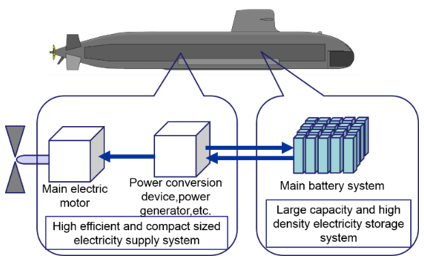
[ Pete Comment: See "Research on high-efficient electricity storage and supply system for submarines" on ATLA website here at https://www.mod.go.jp/atla/en/soubi_kansen.html with the ATLA diagram and description below:

[ATLA explains] "Conduct research on electricity storage system with large capacity and high density, electricity supply system with high efficient and compact sized to extend submarines’ underwater endurance without increasing ship size." ]

GS Yuasa Technology Co., Ltd. (GYT) started mass production of LIB batteries in March 2017. This  proceeded smoothly. In August 2018 GS Yuasa Technology Co., Ltd. (GYT) delivered them to MHI.

After that, the submarine [Soryu Mk. II] JS Oryu was equipped with lithium-ion batteries. The main storage battery computerized management device was integrated into Oryu from the summer of 2019.

After JS Oryu's sea trials, Oryu [with its Lithium-ion Batteries] was handed over to the [Japanese Navy] Maritime Self-Defense Force in the spring of 2020.

2. 2. Development history

GYT established mass production technology for lithium-ion batteries around 1993, and lithium to be installed in submarines in 1994.

GYT proposed the development of an ion battery to MHI's Technical Research and Development Institute (TRDI) [see ATLA's precursor TRDI] at that time under MHI.

In 2003, GYT and MHI's TRDI were contracted to develop "new main storage battery for submarines. [likely by Japan's Ministry of Defense (MoD) which likely provided startup, ongoing and on completion funding].

Participated in "Research Trial"

GYT,  conducted research trials, and completed the development of lithium-ion batteries for submarines.

3. 3. Development overview

3.1 Lithium-ion battery

Lithium-ion batteries [LIBs] generally have the following superior performance compared to lead-acid batteries, so they are used in submarines.

LIBs should contribute to improvements of performance, due to.

・ High energy density: Can store more power and discharge

・ Long life: Reduced number of battery replacements

・ High charging efficiency: Shortening charging time

・ Excellent discharge characteristics: Sufficient capacity can be taken out even with a large current.

・ No hydrogen gas generation: [So no need to take safety measures against hydrogen gas].

・ No maintenance required: No battery maintenance required

・ No maintenance required: No battery maintenance required

Figure 1 [can be seen on Page 2 of the original document] shows the external view of the new lithium-ion battery (hereinafter referred to as SLH type) developed by GYT. 

The SLH LIB's dimensions are specifically designed to be the same size as the preceding lead-acid batteries.

The lead-acid battery was a single cell, while the SLH type configuration is an aggregate of 10 cells  arranged in 2 rows and 5 stages and connected in series. Table 1 [also on Page 2 of the original document] shows the main points of the SLH type.

Table 1 indicates Lithium cobalt oxide, which can achieve high energy density, is used as the positive electrode material.

In addition, as will be described later, the SLH type is equipped with a battery monitoring unit that measures the cell voltage and cell temperature at the top.

[From documentDetails]

Fig. 1 External view of the new main storage battery SLH type

Table 1 Key points of the new main storage battery SLH type

[Table 1 literally translated is:]

Table 1 Key points of the new main storage battery SLH type

Item New main storage battery SLH type

Structure sealed type

Electrolyte Organic electrolyte

Positive electrode material Lithium cobalt oxide [LCO]

Negative electrode material carbon. 

3.2 Battery monitoring unit

Unlike the conventional SCG type lead battery, the SLH type is equipped with a battery monitoring unit. Figure 2  [which can be seen on Page 3 of the original document] shows the battery monitoring unit.

The external view of the device is shown. This battery monitoring unit monitors the voltage and temperature of each cell that constitutes the main storage battery.

It is an electronic device that measures the degree and transmits the results to the main storage battery management device [central computer station terminal]. [This station provides details of any] performance degradation or safety degradation.

Therefore, the station is used to confirm that the battery is working in the correct voltage range and operating temperature range.

In order to ensure [accuracy and safety] the [station video screen] is composed of two completely independent units for regular use and supplementary use, and [can operate] automatically in the event of an [emergency] failure on the regular side.

It switches to the auxiliary side. See Fig. 2 External view of the battery monitoring unit [which can be seen on Page 3 of the original document].

3.3 Battery management system

Monitors and displays the temperature and voltage of many cells mounted on the submarine in real time, and data in each control device, etc.

It has a function to send (battery status). The main storage battery management device is serially communicated from the battery monitoring unit.

Receive data at SCC (Ship Condition Control Console) or automatic charging device

Send the required data. In addition, it consists of two sides, one for the front group and one for the rear group, and all the front and rear groups are single on each monitoring screen.

It is possible to display the battery status.

Fig. 3 Battery monitoring system (joint image) [which can also be seen on Page 3 of the original document]

4. Summary

By installing the new main storage battery SLH type on a submarine, the following two points are the effects that contribute to the performance of the submarine.

Can be mentioned.

(1) Compared to lead-acid batteries, SLH LIBs have a higher energy density, so they are smaller and lighter.

[More SLH LCO LIBs, with higher energy density, can fit into the limited space of the submarine. This is compared to larger, lower density "SCG" lead-acid batteries.] [Direct translation:] Equipped with SLH type, which has higher energy density than SCG type lead battery, in the limited volume inside the submarine.

By doing so, [SLH LCO LIBs] can contribute to the extension of the underwater duration.

(2) No hydrogen gas is generated. Moreover, there is no need to manage the specific gravity measurement.

[SLH LCO LIBs make] maintenance management becomes easier [compared to] the measurement and adjustment of electrolyte specific gravity and liquid level, etc., [necessary with the older] SCG type [lead-acid] batteries, etc.

No maintenance work is required.

5. Acknowledgments

We are very honored to receive the Honor of the Defense Infrastructure Development Association Award.

We will continue to do our best to meet your expectations.

In this development, a large number of people concerned, including the Ministry of Defense [MoD] and the Acquisition, Technology and Logistics Agency [ATLA] will be enormous. [ie. they have made an enormous effort.]

We are deeply grateful for [the Japanese Government's, mainly the your guidance and encouragement.

That is all." 

[Documents ends]
-----------------------------------

See also this other GS Yuasa document, pages 14, 28 and 31, on GS Yuasa supplying LIBs for Japanese submarines.
May 22, 2021

UK Carrier Srike Group on world tour (eg. Med & South China Sea)

See BBC article.

News to me - the article indicates UK strike aircraft based in Cyprus regularly attack ground targets in Iraq.

UK F-35Bs from UK carrier, HMS Queen Elizabeth will soon strike Islamic State targets in Iraq. 

Also many other UK Carrier Strike Group 21 world tour activities and exersizes with allies from May to December 2021 - all the way to the Pacific Ocean and back.
---------------------------------

In great detail Richard Gardner (London) for top source Asia-Pacific Defence Reporter (APDR) reports (in part) in APDR's June 2021 magazine:

"Final preparations have been underway at Portsmouth during late April [2021] for the departure of Carrier Strike Group 21 (CSG21) which will see the largest UK naval deployment to Asia Pacific waters for a generation. The flotilla of ships will deploy for 28 weeks, through the Mediterranean, Indian Ocean and South China Sea into the Pacific and represents the most ambitious Royal Navy overseas projection of sea power since the Falklands Task Force in 1982.

A very wide selection of vessels will be involved, apart from the flagship, the aircraft carrier HMS Queen Elizabeth, and will include Type 45 destroyers, HMS Defender and HMS Diamond, Type 23 frigates, HMS Richmond and HMS Kent, the new offshore patrol vessel, HMS Tamar, an Astute Class nuclear submarine and fleet support ships, RFA Fort Victoria and RFA Tidespring.

Adding an international flavour will be a US Navy Destroyer, the USS Sullivans, and a Dutch frigate, HNLMS Evertse. As well as promoting defence exports along the way, and underlining the UK’s renewed commitment to a more global outreach, the opportunity will be fully exploited to exercise sea and air assets with other friendly nations, gaining experience through cross operating with very diverse equipment and capabilities, including co-ordinated command and control and tactical operations.

The carrier air group will see the intensive use of new aircraft types working together on a longdistance deployment for the first time. The 18 F-35B combat aircraft will see crews from the Royal Navy, RAF and US Marines working together as a group, following intensive training and working up on the new aircraft in the USA and UK. For the Royal Navy the step up in combat capability is considerable, moving to a stealthy, supersonic, fifth-generation fighter/attack platform, aboard a highly automated 65,000 tonne carrier.

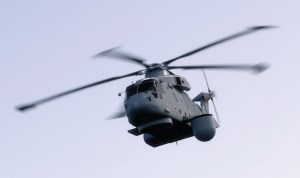
Merlin helicopter (R Gardner photo)

The RN has suffered a serious capability gap in recent years following the withdrawal of three Invincible Class 22,000 tonne carriers and their Sea Harrier and Harrier GR9 aircraft. However, the deliveries of UK F-35Bs to date have been relatively small and are being spread three ways between development and training units in the USA and UK and just a single operational squadron, No 617, a joint RAF/RN unit.

The second operational squadron, No 809 Naval Air Squadron, will become operational in 2023 when 37 F-35Bs should be deployable. On CSG21 the inclusion of a USMC squadron within the air group is a bonus for both the UK and USMC and the huge four acre deck and vast hangar of the new carrier has been designed to accommodate 40 aircraft, so operating and maintenance space is not a problem. Several Asia-Pacific nations will be taking a particular interest in seeing up close how the F-35Bs can work closely with helicopters as many already have, or are planning, new small carriers and since the demise of Harrier production, there is currently no other combat jet apart from the F-35B that can use them. The USMC may be the largest user of F-35Bs but is still operating Harriers on its own helicopter landing platform ships as it transitions to the new aircraft.

NEW HELICOPTER PLATFORMS [see in APDR's June 2021 magazine]

Over 40 different countries will be visited during CSG21 and the ships will conduct extensive sea exercises, expected to include working with ships and aircraft from India, South Korea, Singapore,

Taiwan, Japan and Australia. The passage to Japan is expected to be controversial and will involve a balance between avoiding what might be regarded by China as provocation in their backyard, and the opportunity to display a robust show of resolve in support of regional maritime forces committed to the protection of internationally recognised free shipping routes across the South China Sea.

DAZZLING SPECTACLE

One of the new Royal Navy ships will be reviving a tradition that has not been seen at sea on a Royal Navy ship since the end of the Second World War. The OPV HMS Tamar is heading to the A-P region carrying a “dazzle” camouflage paint scheme incorporating various shades of black, white and grey in unusual shapes. This was designed to make it most distinctive - but the purpose of this scheme is the use the different shapes, angles and colours to make the ship harder to identify and to confuse those seeking to calculate its speed and direction, especially when looking through a submarine periscope.

Commander David Louis, Commander of the Overseas Patrol Squadron said... "The Royal Navy’s ships will once again become more familiar in Asia-Pacific waters after CSG21 returns to the UK, and will be followed by further deployments of frigates and larger ships next year."

SEE FULL ARTICLE IN APDR'S JUNE 2021 MAGAZINE

May 18, 2021

Heart-Rending Video: Enemies become Friends

The highs and lows of a B-29 (all surfaces shredded but still flying) and its crew, eventually shot down by Zeros and by a Ki-45 over Tokyo. 

Note at the time of the action some B-29s still had a 20mm cannon in the tail. The tail armament was then modified to all 0.50 calibers in line with all other gun turrents of B-29s. The common 0.50 caliber made ammo logistics/provision and reloading much easier.

See the less than 10 minute Youtube here and be low:


Pete