February 20, 2020

Australian Future Submarines: How Many? And Basing?

From some comments on down from MHalblaub's comment (of February 19, 2020 at 7:05 AM)

HOW MANY AUSTRALIAN FUTURE SUBMARINES?

The Australian Navy (RAN) has had continuous problems since the 1970s finding commanders and crew for more than 5 submarines.

-  Commanders must now pass the conventional submarine Dutch Navy "Perisher" Submarine
   Command Course and about 40% fail. The UK RN used to run the course but no longer since the
   UK went all nuclear subs.

-  the shortfall in numbers of Australian submarine commanders has been partly met by
   ex UK Royal Navy submarine commanders.


-  A Commander for a small Baltic 1,000 tonne sub needs to be as well qualified (hence is as hard to
   find and train) as a Commander for a 4,500 tonne (surfaced) Attack class sub. So Australia
   finding 20 commanders, for any suggestion of 20 small submarines, is an illusion.

-  due to the hardship of long missions underwater (away from family) and higher paying jobs in the
   mining industry the RAN has been unable to raise crews to rotate (on missions/on courses/on
   leave) more than 4 submarine equivalents at any one time.

So suggestions we should have 12 submarines might only be justified during a time of medium-long term increase in the threat environment to Australia. A training effort would need to be more than doubled which involves training on surface fleet ships before transitioning to submarines.

In the current threat environment I think the RAN has followed the standard practice of talking more submarines (12) than it expects to receive (8).

You will note I wrote on another website in December 2014:

"A requirement for twelve submarines was an uncosted, minimally justified, extravagance included in the 2009 White Paper (page 70, section 9.3) drawn up under the Rudd Government. There appears to be a historical trend of shooting high in Australian submarine numbers.


No navy is launching 2 conventional classes of small and large submarines because it complicates training (for crews and commanders), HQ command, control, basing slots and deployment. It also increases costs of basing (again), training (again), maintenance, repair, overhaul and spare parts.

--------------------------------------------------------

BASING?

Basing is much more complex than how far north(?) and sea depth issues. Its all about people.

To get a handle on just some of the aspects it pays to read the Australian Department of Defence Future Submarine "FSM BASING STUDY" dated 2011 via the "Wayback Machine" is at 
https://web.archive.org/web/20210804160533/https://www.defence.gov.au/FOI/Docs/Disclosures/373_1718_Documents.pdf

Also see this 2022 article.

The takeaways include an Australian submarines base on the East Coast (or whole new Fleet Base East) needs to be in commuting distance to large urban areas/cities:

-  for families and specialist naval and civilian personnel, for administration, housing, maintenance, training, submariner retirement or part-time work and many other functions

-  protected by several surface ships (and I'd add maritime patrol aircraft) for that vulnerable travel
   leg immediately outside bases

-  large cities already includes Sydney. Maybe Brisbane or even Gladstone, Queesland) for the many support industries needed and (healthcare, education, jobs, inexpensive housing for) families and submariner retirement options.

Darwin is not viable as it is too small to for the full range of support services needed. It is also too exposed to possible future Chinese air and naval bases in close by East Timor, Solomons or PNG. Also the shallow nature of Darwin Port, tides and 100 year lease to a Chinese company (required under Chinese rules to be close to the Chinese Government) don't help.

So Australia submarines need to be permanently based in/near to cities over a million (fairly standard for other navies worldwide). 

Pete

February 19, 2020

French, Russian, Israeli to India Nuclear Weapons Sharing

Further to February 17-18, 2020 comments:

As I wrote in 2012 "It is likely India would seek (has received) cold and hot test results - most probably from Russia and perhaps from France and Israel (noting Indo-Israeli joint tests of nuclear (intended) missiles)."

Over the years I have commented on Submarine Matters that:

- as Russia definitely helped India with the INS Arihant reactor, and

- as India paid such high prices for the Chakra II/Nerpa refurbishment and conversion of the INS Vikramaditya carrier

in return the Russians assisted India with several aspects of Agni series, K-4 missile technology including MIRVing and Russian 2 stage "thermonuclear test results and perhaps designs".

Israeli nuclear and India

It is widely accepted that US intelligence sensors detected an Indian and Israeli nuclear missile test in the Indian Ocean in 2002.

"Popeye Turbo" is a cover name that could apply to a cruise missile, ballistic missile or a "2 stage" combination of turbojet then a rocket assisted Mach 3 end run.

France and Israel

France supplied the Jericho I technology, Dimona reactor and Plutonium reprocessing construction to Israel. Details could have been passed on to India. French MIRV technology could have then passed to Israel for Jerichos II and III and then passed to India.

According to (then serving) Lieutenant Colonel Warner D. Farr, in his 1999 report http://large.stanford.edu/courses/2015/ph241/tilney1/docs/farr.pdf to the USAF Counterproliferation Center:

"Progress in nuclear science and technology in France and Israel remained closely linked throughout the early fifties." Furthermore, according to Farr, "There were several Israeli observers at the French [1960s] nuclear tests and the Israelis had 'unrestricted access to French nuclear test explosion data.[6]”

As French and Israeli (and some Jewish diaspora scientists working for third countries) nuclear weapon research has always been a 2 way informational deal there is no particular reason French 2 stage fusion details stopped going to Israel in the 1960s.

Additional 2 stage details continued (may well continue) and Israeli passage of some to India is a possibility.

Alot to take in.

Pete

February 17, 2020

French Future SSN & SSBN Priorities Before Attack class

Following comments of February 15/16, 2020 from Anonymous and Arpit Kanodia

Due to Australian July 2016 Federal election priorities (specifically votes for jobs in South Australian) Australia chose DCNS (now Naval Group), too early as the winner of the submarine competition.

Australia should have retained a two or three way competition (with Japan and/or TKMS/Germany) until at least 2018 when 2 or all 3 had a more complete designs and costings. Delays now mean Naval Group will only "cut steel" on the Attack class in 2023 (and I'd say, more likely, 2024).

So Australia now is relying on French Government owned Naval Group. But the French Government has already ordered Naval Group to tackle 2 major French submarine national security priorities first. That is before Naval Group gets round to doing serious work on the Attack class.

1. France is yet to complete a great deal of development work on the far from operational Barracuda SSN program. France is mindful that its preceding Rubis class SSNs are already up to 41 years old with the Rubis launched in 1979.

2. France has a great deal of work to do on its 15 year replacement SSBN program
    - in order to start replacing the preceding Triomphant class SSBNs by 2033.

So France's replacement SSN and SSBN programs are of higher priority for French Government owned Naval Group management, designers and workers than the Attack class program that Australia cannot walk away from.

The Australian Federal government knows it has nowhere to go now. It would lose too much face (political capital - including votes in South Australia) if it said it was wrong to choose France so early.

I'll write about any Japan option after I see what you readers think.

Pete

February 13, 2020

Reducing the Collins & Victoria Rust Trend for Australia's Future Submarines

In response to /Kjell’s comment of February 13, 2020:

Much of the Victoria class' current maintenance problems are rust-corrosion going back as far as their long term UK storage when they were Upholders. Rust is an iron oxide while corrosion is a broader term encompasing destructive changes to iron, other metals, alloys,  ceramics and polymers. 


"the submarines deteriorated while in storage [sitting in seawater] and the Royal Navy was not completely forthcoming on their condition during the sale."

-----------

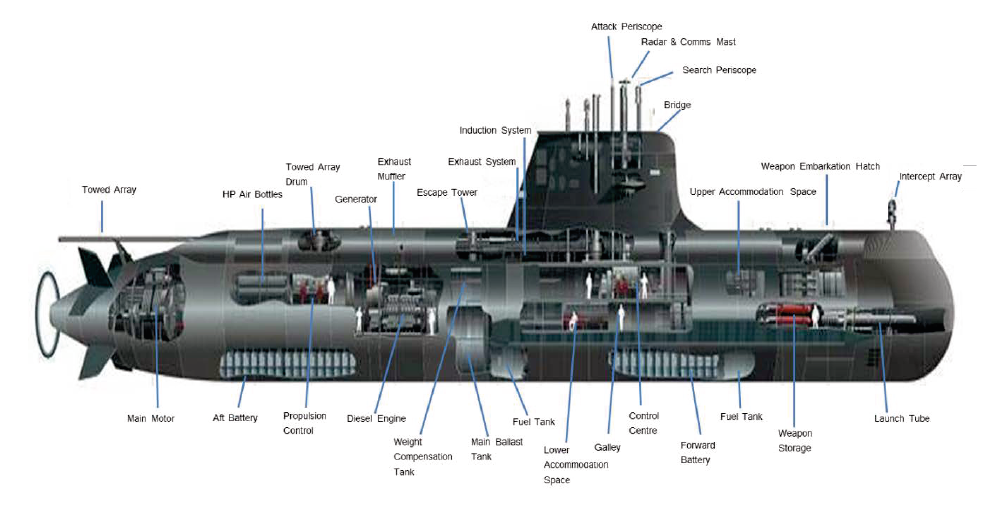
The complex fuel-water -ballast-buoyancy system of "fifteen" tanks for the Collins also suffers from excessive rust-corrosion.

See https://en.wikipedia.org/wiki/Collins-class_submarine#Propulsion_system

And see this Collins submarine image showing 2 of the Fuel Tanks and the Main Ballast Tank .

This is a major reason for the excessive A$700 million/year total maintenance bill for the Collins.

-----------

So Naval Group is especially mindful of reducing rust-corrosion problems in the 12 Australian future submarines.

Pete

February 11, 2020

Russian/Italian Joint Venture? S1000 Submarines? for Qatar?

PressTV, February 9, 2020 reports:

"Qatar is reportedly expected to acquire submarines from Italy and turn into the first Persian Gulf Arab country to operate those watercrafts.

The American business magazine Forbes reported that a new memorandum of understanding (MoU) with Italian company Fincantieri, Europe's largest shipbuilder, covers the “supply of cutting-edge naval vessels and submarines” to the Qatari Emiri Navy.


"Qatar may become the first Arab Persian Gulf state to operate submarines," the report said, adding that currently Iran is the only submarine operator in the Persian Gulf.
According to the report, the Qatari submarines, which are likely to be relatively small light ones, may be part of a much larger 5-billion-euro deal with Italy which was agreed in 2017.
...It further said that Saudi Arabia and the UAE, two of Qatar’s neighbors embroiled in a diplomatic crisis with Doha, have both stated needs to acquire submarines.
"Qatar has difficult relations these countries so the submarine acquisition could be seen, at least in part, as a response to these moves," the report added. [Pete Comment - oddly Qatar, which sits in the Persian Gulf, enjoys good relations with Iran.]

See H I Sutton's original Forbes article, of  February 4, 2020:
https://www.forbes.com/sites/hisutton/2020/02/04/qatars-massive-naval-expansion-to-include-submarines/#200f905b322e.

Pete Comment

Italian shipbuilder Fincantieri joint builds with TKMS of Germany the Type 212A/Todaro class  conventional subs.   

Fincantieri is apparently joint marketing with Russia's ROSOBORONEXPORT (with RUBIN Design Bureau as the joint builder) a smaller 1,000 - 1,100 ton concept submarine,  known as the "S1000" (see artwork with specifications below). 

S1000's "TECHNICAL INFORMATION"  section indicates the S1000 can be fitted with an Air Independent Propulsion "AIP capability (Fuel cell based) 200 kW".

As Italy is a NATO country, with access to high submarine tech, the idea of Fincantieri joint marketing with Russia the S1000 (which could be fitted with the Fuel Cell AIP system (designed in Germany? Still holding German intellectual property rights?) might be problematic.

Russian industry (in the Kilo sub ) has been unable to develop an AIP systems to compete with those of Western firms. Russia would find AIP in its Russian Navy Lada submarines to be strategically useful against the West. If Russia could at last incorporate Western AIP into its long awaited, but so far not exported, Amur 1650 and smaller Amur 950 submarines, such Russian exports could represent $Billions lost by Russia's Western submarine competitors.

Possibly Fincantieri might build much smaller submarines for Qatar (Italy has a long history building small subs) without any AIP tech/Russia complications. 


The S1000 concept submarine being marketed by Russia and Italy's Fincantieri (can include AIP).
(Artwork and specs courtesy Fincantieri)
--- 

Pete