August 30, 2013

Rossetti - Great Artists


The Beloved by Dante Gabriel Rossetti (1865-1866). This work is currently at the Liverpool (UK) Museum, on loan from Tate Gallery, London. In The Beloved, Rossetti looked beyond the Caucasian type of beauty. Each of the bridesmaids has a darker skin than the bride. The one centre right, half-hidden, was painted from a Mrs Eaton, who sat for Jewish subjects by other artists. The bridesmaid on the extreme right was modelled a Romany woman who was a model and mistress of the artist Frederick Sandys. Quite early on in the planning of 'The Beloved', Rossetti wished to include a little black girl carrying a cup before the Bride. This was later changed to a black boy. This was the period of the American Civil War and the questions of slavery and abolition were hot topics in the newspapers. Rossetti's brother William, his sister Christina and other artist friends came out on the abolitionist side but Rossetti's views on the issue are not clear. Was the black boy an attempt to allude obliquely to the slavery question in his picture?
 
I'm as interested in songs and art as in weapons technology.
 
Dante Gabriel Rossetti (12 May 1828 – 9 April 1882) was an English poet, illustrator, painter and translator. He founded the Pre-Raphaelite Brotherhood in 1848 with William Holman Hunt and John Everett Millais, and was later to be the main inspiration for a second generation of artists and writers influenced by the movement, most notably William Morris and Edward Burne-Jones. Rossetti had an obvious interest in woman (which I share :)

The Pre-Raphaelites believed the Classical poses and elegant compositions of Raphael (who painted most of his works in the early Sixteenth century (up to 1520) in particular had been a corrupting influence on the academic teaching of art. The brotherhood wanted a return to the abundant detail, intense colours and complex compositions of Quattrocento (Fifteenth century) Italian art hence Pre-Raphael.

More details of Rossetti's life, his models, poetry and pictures are here http://hoocher.com/Dante_Gabriel_Rossetti/Dante_Gabriel_Rossetti.htm .


Self portrait of Rossetti (1847)


Bocca Baciata 1859. The model was Fanny Cornforth, the principal inspiration for Rossetti's sensuous figures.


Alexa Wilding (1879) her real name.


Portrait of Marie Spartali Stillman (1869)


Venus Verticordia (1864-1868). From 1864 till his death Rossetti was constantly altering this great work. Nothing is perfect.


Joli Coeur (1867) - very saucy.


Woman Combing Her Hair (1865)


Proserpine (1874) (the model was Jane Morris (1839-1914))
 
 
I'll add more to this odd assortment of weapons, songs and art as I can.
-
Pete 

August 22, 2013

Pakistan's growing nuclear capabilities

---

In the realm of speculation - it is hard to be sure whether Pakistan has a thermonuclear capability (ie. H bombs).

While Pakistan's industrial and likely scientific base suggests it doesn't have H-bombs most Pakistani nuclear weapons designs and much testing were most probably courtesy of China. So no-one other than China and Pakistan itself know if China supplied H-bomb designs or even devices to Pakistan as a counter to India's likely H-bomb capability.

Russian nuclear weapon assistance to India is likely given the known scale and depth of India-Russian strategic and weapons relations. This includes excessive amounts of Indian defence money paid to Russia for oddly unproductive projects like INS Vikramaditya, known Russian assistance in building the reactor for INS Arihant and leasing of INS Chakra I and the current nuclear propelled INS Chakra "II" (ex Nerpa). 

-
Below are more confidently known details on Pakistan’s nuclear weapon programs partly drawn from pages 51-58 of Zia Mian's Pakistan chapter in Ray Acheson's (edit), Assuring Destruction Forever: Nuclear Weapons Modernisation Around the World, Reaching Critical Will, New York, March 2012. download: http://reachingcriticalwill.org/images/documents/Publications/modernization/assuring-destruction-forever.pdf (note its 6.11 MB) or try https://www.princeton.edu/sgs/faculty-staff/zia-mian/Pakistan-nuclear-modernization-2012.pdf.
-
Pakistan is moving from an arsenal of weapons based wholly on HEU to greater reliance on lighter and more compact plutonium-based weapons. This is being made possible by a rapid expansion in plutonium production capacity, with two production reactors under construction to add to the two reactors that are currently operating. Pakistan has received direct assistance from China for its nuclear weapons and missile programs, from North Korea for its missile program and unintentionally enrichment technology from Urenco (through A Q Khan's espionage).
-
There is almost no information about the funding of Pakistan’s nuclear weapons programme. Pakistan’s nuclear weapons production is probably and unintentionally cross-subsidized from large amounts of military aid from the United States. Between 2001 and June 2012 Pakistan may have received US$24 billion in aid from the United States, of which over $15 billion was military assistance, over $7 billion in economic aid and over $1 billion in covert funding (including bribes) to ISI and other influential institutions.
-
Some Chinese aid might be intentionally earmarked for the nuclear program. There are rumours that the Saudi aid is tied, in the sense that the Saudis have generated Pakistani indebtedness which would demand Pakistani nuclear assistance if Saudi Arabia were under nuclear threat (presumably from Iran or Israel).
-
Meanwhile US intelligence and Special Forces are believed to be fairly confident (although perhaps not 100%) that they can locate and destroy all of Pakistan's nuclear weapons if military and civil order breaks down and prior to suicide-jihadis siezing the weapons. 
-
Up to 130,000 Pakistanis are believed to be involved in nuclear weapon, research, production, deployment and guard duties. This may absorb all aid Pakistan receives from all countries, including tribute from Afghanistan. 
-
Pakistan may also have developed more advanced ‘boosted’weapons, which inject tritium gas into the pit just before it explodes thus increasing the proportion of fissile material that actually undergoes fission -therefore significantly increasing the explosive yield of the nuclear weapon. Pakistan is not believed to have developed thermonuclear weapons (hydrogen bombs).
-
Pakistan's tactical/battlefield and strategic nuclear missiles (under Army Strategic Force Command) and "nuclear" fast jets, under Air Force Strategic Command, all have km ranges designed for deterrence/conflict with India. Secondary uses might include deterrence of US forces in Afghanistan, in Middle East bases, and against carrier groups offshore.

A deterrent role against mainly Shiite Iran will be added when/if it has a nuclear capability (Pakistan is mainly Sunni). Pakistan has generally good relations with Iran, but this has been put under strain by Taliban activities and illegal population movements both ways to/from Baluchistan.
-
Pakistan's nuclear capable, fast jets include the F-16 and Mirage V.
-
Pakistan is moving from liquid-fueled missiles (like the Gauris)  to solid-fueled (like the Shaheens) missiles (with solid fuels promoting rapid launch, safety and greater mobility). Pakistan has received assistance from North Korea and China with its missile programme. Pakistan's ballistic and cruise nuclear capable missiles, by increasing range, are:

- the 60 km range, Nasr (NSAR or Hatf 9) battlefield nuclear missile, first tested in 2011, to be deployed 2014.

- the Abdali (Hatf 2) missile, range approximately 180 km, a simple solid fueled missile that Pakistan deployed 2012 (?).

- Ghaznavi (Hatf 3), notional range of 290 km to conform to the MTCR given its possible Chinese origins, range may actually be 400 km, deployed 2004 

- an air launched 350 km range, Ra’ad (Hatf 8) cruise missile under test from 2007, to be deployed 2013(?).  

- Pakistan is also developing a nuclear-capable 600 km range, ground-launched Babur (Hatf 7) turbojet, cruise missile, deployed 2011(?).

- Shaheen-I, 750 km range solid-fueled  It is believed to be derived from the Chinese M-11 missile, with China handing over 34 M-11 missiles, Shaheen I's now locally built (?), deployed 2003.

- the Ghauri I - Gauri II suffer from being liquid fueled, with estimated range 1,200 to 2,300 km (depending on rocket motor capability and warhead weight),

- Shaheen II (Hatf ) is a 2,000 km range, solid fuel missile, deployed 2011 (article).
 
- Shaheen-III believed under current development with solid fuel stages and expected range of around 4,500 km.
According to a secret US cable published by Wikileaks, US officials suggested in 2008 that Pakistan was producing nuclear weapons at a faster rate than any other country in the world. US Government estimates Pakistan’s stockpile to range from 90 to over 110 weapons.
-
The 2005 India-Pakistan Agreement on Pre-Notification  of Flight  testing of Ballistic Missiles commits the two states to provide 72 hours notice before a ballistic missile flight test and to not test missiles close to their borders.
-
Like India Pakistan is not a signatory to the nuclear Non-Proliferation Treaty (NPT), nor signed the Comprehensive Test Ban Treaty (CTBT).
-
As in most nuclear weapon states Pakistani governments have sought to create a positive image of the nuclear weapons program (particularly missile launches often by linking it to national pride and national identity.
-
There is little public information about the storage and deployment of Pakistan’s nuclear weapons (but much publically derived or acquired satellite imagery). As many of Pakistan's missiles are believed to be transported in non-military, commercial looking covered trucks (hiding TEL) non-state observers would have trouble keeping track .
-
There is also no official information on Pakistan’s fissile  material production sites—although Pakistan and India each year exchange lists of nuclear facilities as part of their 1988 Agreement on the Prohibition of Attack against Nuclear Installations and Facilities. though see http://isis-online.org/isis-reports/detail/construction-progressing-rapidly-on-the-fourth-heavy-water-reactor-at-the-k/12#images and overall see http://isis-online.org/isis-reports/imagery/category/pakistan/
-
Pakistan’s nuclear weapons are widely seen as a response to India’s nuclear weapons and its larger conventional military forces, and the experience of wars in 1947, 1965, 1971, and 1999. Pakistani fears of Indian hegemony have increased in recent years as India’s economy has started to grow at a much faster rate than Pakistan’s and as India has increased its already much larger military budget at a much faster rate.
-
A longer-term concern now driving Pakistan’s nuclear programme is the United States’ policy of countering the rise of China as a potential great power competitor by cultivating a much stronger US strategic relationship with India. This latter concern may tie the future of Pakistan’s nuclear weapons, and those of India, to the emerging contest between the United States and China.
-
Pete

August 20, 2013

Pakistani Nuclear Forces 2011 - Megatons of Comfort

Click on chart to download readable full size version.
(Graph courtesy of FAS Strategic Security Blog)

 Hans M. Kristensen and Robert S. Norris of FAS Strategic Security Blog report (17 July 2011) that Pakistan’s nuclear arsenal has doubled since 2004 and could double again in the next 10 years if the current trend continues. Kristensen and Norris continue:

“The latest Nuclear Notebook on Pakistan’s nuclear forces is available on the Bulletin of the Atomic Scientists web site. Since our previous Notebook on Pakistan in 2009 there have been several important developments.

Based on our own estimates, official statements, and fissile material production estimates produced by the International Panel of Fissile Materials, we conclude that Pakistan’s current nuclear weapons stockpile of 90-110 warheads might increase to 150-200 within the next decade. This would bring the Pakistani stockpile within range of the British stockpile, the smallest of the original five nuclear weapon states, but still far from that of France (despite some recent news reports to the contrary).

This development is precipitated by the anticipated introduction of several new nuclear delivery systems over the next years, including cruise missiles and short-range ballistic missiles. The capabilities of these new systems will significantly change the composition and nature of Pakistan’s nuclear posture.

India is following this development closely and is also modernizing its nuclear arsenal and fissile material production capability. The growing size, diversity, and capabilities of the Pakistani and Indian nuclear postures challenge their pledge to only acquire a minimum deterrent. Bilateral arms control talks and international pressure are urgently needed to halt what is already the world’s fastest growing nuclear arms race."

-
Pete

August 19, 2013

India helped US U-2s spy on China and Russia


A taxiing U-2 in its earlier 1960s configuration. Perhaps of the type that operated out of Charbatia Air Base in Orissa State, Eastern India, 1964-1967. Earlier U-2s had secretly operated from Badabare Air Force base, near Peshawar in Pakistan.

From the excellent US website IntelNews, August 19, 2013 http://intelnews.org/2013/08/19/01-1324/

"Report reveals secret US-India Cold War collaboration"

By JOSEPH FITSANAKIS | intelNews.org |

During much of the Cold War, India enjoyed a close diplomatic and military relationship with the Soviet Union. But a newly declassified document reveals that the South Asian country allowed the United States to spy on the Soviets using its airspace. The revelation is contained in a 400-page history of the American U-2 reconnaissance aircraft program authored on behalf of the US Central Intelligence Agency (CIA). The formerly classified document, written in 1992 by CIA historians Gregory Pedlow and Donald Welzenbach, is titled: The Central Intelligence Agency and Overhead Reconnaissance: The U-2 and OXCART Programs, 1954-1974. It was declassified last week in response to a 2005 Freedom of Information Act request filed by Jeffrey T. Richelson, Senior Fellow at George Washington University’s National Security Archive.

The Central Intelligence Agency had been involved in U-2 reconnaissance missions since 1954, when the spy program began. Known officially as Project HOMERUN, the U-2 program was a joint effort by the CIA and the National Security Agency that surreptitiously gathered signals and photographic intelligence on Soviet military sites. The program, which has been described by some historians as one of the most successful intelligence projects in US history, relied on the U-2’s ability to fly beyond 70,000 feet over the Soviet Union, thus avoiding detection or attack by Soviet forces. That assumption, however, proved to have been false. In reality, Soviet radars had been able to detect nearly every U-2 flight over Soviet territory.

Eventually, on May 1, 1960, Soviet forces managed to shoot down one of the U-2 flights using a surface-to-air missile. This led to the so-called ‘U-2 incident’, during which India sided firmly with the Soviet Union, criticizing the US for violating Soviet airspace.

But New Delhi’s attitude to the U-2 program appears to have changed drastically following the Sino-Indian conflict on October 1962, when Chinese forces launched a series of armed incursions into Indian territory, killing over 1,000 soldiers. Soon afterwards, India approached the US and asked for military assistance; the US response was to offer to deploy U-2 airplanes from in Thailand, in order to spy on the Chinese forces along India’s eastern flank. India’s Prime Minister, Jawaharlal Nehru, agreed to allow the U-2 aircraft to refuel in Indian airspace.

According to the CIA history of the U-2 program, the Chinese detected the spy flights and logged official protests with both India and the US. But New Delhi’s response was to intensify its cooperation with Washington.

In early 1963, during a visit to India by US President John F. Kennedy, India offered to build an air base on its territory to be used exclusively by the CIA. The Agency made use of the Charbatia Air Base, in eastern India, for nearly four years, from 1964 to 1967, to spy on both China and the Soviet Union’s missile bases in Kazakhstan. It is not known whether the Soviets were aware of this secret collaboration between India and the US.

The declassified history is now available in full on the National Security Archive’s website."
-
Pete

August 18, 2013

Launch of INS Vikrant, India's first locally built aircraft carrier


INS Vikrant, India's first locally built carrier, at its launch on August 12, 2013. The lack of an island and other essentials indicate it will need 3 or 4 more years until construction ends. Then 3 to 4 years of trials before it goes into service.
 
 
There are some in Pakistan whose knee-jerk reaction is to match what India has in every weapon category. As indicated below aircraft carriers are very large and expensive. They are of greater use for long range power projection than defensive uses. A country also needs a minimum of two or three. As all Pakistani ports and exit points are in easy reach of Indian airpower Pakistani carriers would be highly vulnerable in wartime. The opportunity costs suggest Pakistan would be better off building more submarines than an aircraft carrier or three.
 

http://articles.timesofindia.indiatimes.com/2013-08-12/india/41331820_1_aircraft-carrier-warship-defence-minister-ak-antony:

"India launches first indigenous aircraft carrier INS Vikrant"

On August 12, 2013 India launched its first locally built aircraft carrier, INS Vikrant, of 37,500 tonnes at Kochi shipyard, on India's southern west coast. It is almost four-and-a-half years after its keel was laid. Vikrant will probably be in regular service in 2020.

Vikrant will carry 12 MiG-29Ks and eventually 8 HAL Tejas light fighters, as well as 10 medium-large helicopters. Launch of jets will be by ski-jump and landing by conventional arrestor gear - similar to Russia's Admiral Kuznetsov.

One excellent comment from Bob at http://warships1discussionboards.yuku.com/topic/23711/India-Launches-New-Carrier?page=1#.UhA5c51-_X4 is:

"The project has suffered terrible delays and monstrous cost overruns from the beginning. Designing a carrier from scratch is no easy feat, but toss in India’s lack of experience constructing large warships and notoriously corrupt & inefficient military procurement process, and it was headed for trouble from the start. Add to this the problems with system integration that come from sourcing material, weapons, electronics, propulsion, power generation, design work, aircraft, and other parts of the weapons system from hundreds of different companies in a half dozen different countries around the world. And top it off with the fact that some of these countries do not get along, and they speak half dozen different languages, and it is a bit of a minor miracle that the thing got built at all.

India has never designed a large warship before, let alone a carrier with rather unique design requirements. The nations with conventional carrier experience do not build ski-ramp carriers; the nations that build ski ramp carriers for Harrier-type planes do not build ones large enough to operate high-performance fixed wing aircraft like the MiG-29, Rafale, or F-18 from. Russia comes closest, but when India started this process in 1999 the Admiral Kuznetsov design was already 20 years old, and the ship had spent more time under repair that it had at sea. Not that the Russians have ever really mastered carrier operations even now, but back then the whole Russian carrier project looked like a dud.

Once they got past the design weirdness, there were monumental construction problems. India signed a big contract with Russia to purchase all the shipbuilding grade structural steel, three basic types for use in various parts of the hull, over 26,000 tons to flow to the project in a steady stream over several years. But Russia proved incapable of delivering it at all, let alone on time and on budget. So there was a long and costly delay while India basically built three new steel mills and set up a shipbuilding grade steel industry from scratch to meet the needs of the project. No small task considering not only the quantity, but also the quality needed as compared to the usual rebar-quality re-rolled steel that comes out of Indian mills.

Then actual construction started, but there was no dock large enough for the ship. So they started in a dock too small for the hull- it would have to be assembled to about 20,000 tons out of about half of the over 850 lift blocks, floated out, and finished in a larger dock that was to be built. But changes in plans resulted in the ship being floated out at only about 17,000 tons, with construction continuing in a basin until a large dock was finally finished, which allow the ship to be out of the water for propulsion installation.

Then the Indian company providing the main gears dropped the ball and design took much longer than expected. Then there was an issue with the generators, which if I recall correctly were destroyed in some train accident, and the replacements were both delayed and initially installed incorrectly. System integration was not seamless either, as the turbines and control systems were from other countries.

Now issues are popping up with the planned integration of the radars, combat information systems, weapons, electronics, and other systems, as they were all purchased from different nations and not really designed to work together.

All this adds up to five years worth of delays between keel laying and commissioning, and a ship that costs something like 3 times initial estimates.

So the fact that India did not just walk away, and has instead decided to build the second in the series without any foreign help, shows just how committed they are, with budgetary concerns taking a back seat to getting the job done."
-
Pete

August 16, 2013

Tragic loss of 18 crew on INS Sindhurakshak


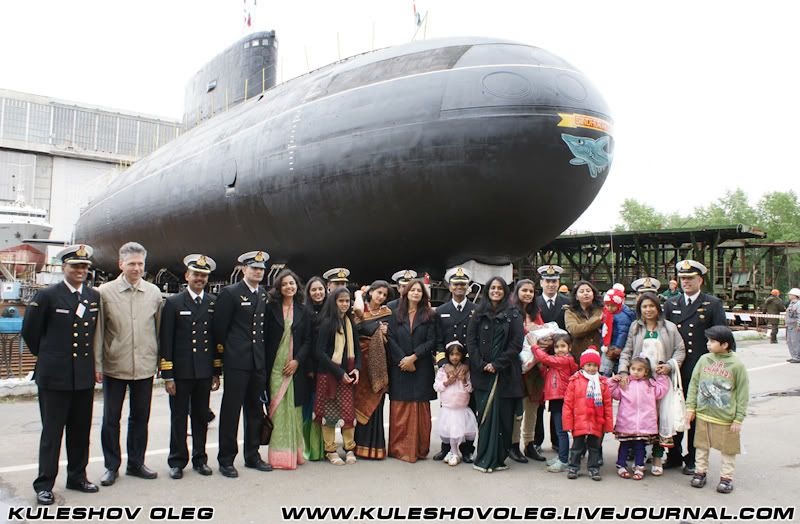
INS Sindhurakshak officers and family in happier times.
-
 
This news story has been carried internationally including US (Yahoo), UK (BBC) news outlets and wire services (including REUTERS).

There has been a tragic loss of 18 crewman on INS Sindhurakshak due to explosions . Based on previous incident-explosions on diesel-electric submarines one possible cause may be the buildup of hydrogen,  from battery charging operations, then ignition by flame or sparks - see http://www.hindustantimes.com/India-news/NewDelhi/INS-Sindhurakshak-hydrogen-concentration-may-have-triggered-explosion/Article1-1108159.aspx . Leakage of missile or torpedo propellant fuel then ignition then explosion of  warheads is possible.

The Sydney Morning Herald based on The New York Times, August 17, 2013 reports "Officials believe that a small explosion within the submarine set off two huge blasts from its onboard munitions. Video of the explosions seems to show two separate bursts that threw flames hundreds of feet into the air." http://www.smh.com.au/world/divers-recover-4-bodies-from-sunken-indian-submarine-ins-sindhurakshak-20130817-2s31i.html


Yahoo via REUTERS reports August 16, 2013 on the tragic loss of 18 crewman on INS Sindhurakshak http://news.yahoo.com/bodies-two-sailors-found-indian-submarine-wreckage-045322241.html

"Indian navy says three bodies found in submarine, no chance of survivors

By Sanjeev Miglani

NEW DELHI (Reuters) - - India's navy said on Friday divers had found the bodies of three sailors who were on board a submarine badly damaged by a fire and explosions and that it was unlikely any of 15 other missing crew members would be found alive.

Eighteen sailors were missing after weapons stored in the forward section of the Russian-built INS Sindhurakshak exploded in the middle of Tuesday night, causing a fire as it lay berthed in Mumbai, the navy's worst losses in more than four decades.

"The state of these bodies and conditions within the submarine leads to firm conclusion that finding any surviving personnel within the submarine is unlikely," the navy said in a statement.

"The damage and destruction within the submarine around the control room area indicates that the feasibility of locating bodies of personnel in the forward part of the submarine is also very remote as the explosion and very high temperatures, which melted steel within, would have incinerated the bodies too."

The sinking of the diesel-powered submarine is the biggest blow for the navy, both in terms of lives and the loss of a vessel, since a frigate was sunk in the 1971 war with Pakistan.

It has turned the spotlight on the navy's ageing submarine fleet even as it spends billions of rupees on aircraft carriers to counter the rising influence of the Chinese navy in the Indian Ocean.

The Sindhurakshak is a Kilo class vessel, which were built in former Soviet and later Russian shipyards for the Indian navy from 1985 to 2000. The navy has 10 of the submarines and four German HDW boats.

A defense source said the navy did not have a deep submergence rescue vehicle that other navies use to save trapped sailors, although in this case the incident occurred while it was docked and not in the deep seas.

The navy said divers couldn't enter the Sindhurakshak for more than 12 hours because of boiling water inside parts of the vessel. Access was "almost impossible due to jammed doors and hatches, distorted ladders, oily and muddy waters".

Only one diver could work at a time initially to clear a path inside the submarine. Divers are trying to reach further inside to find the remaining bodies, the navy said.

A naval board of inquiry has been ordered into how weapons went off while the vessel was berthed in the high-security Mumbai base.

Weapons on board such a submarine include torpedoes and missiles that are launched over long ranges above water."
-
Pete