Pete Comment: I think its rare for the types of equipment below being advertised in detail publicly. Naval intelligence value usually makes the whole subject classified. So, while this information is still in the public realm I've posted it below.
[Advertising Datasheet]
DASA-2507 - Digital Acoustic Surveillance
Arrays
Internet file https://omnitechelectronics.ca/products/arrays/dasa-2507/
as at February 24, 2026
Datasheet: Part Number: DASA-2507
DASA-2507 is a
low-frequency acoustic sea-bed array platform designed for long-term area
monitoring and surveillance applications. This DASA variant has 94
low-frequency hydrophones installed to form 6 linear apertures (10, 20, 40, 80,
160, 320 Hz) spanning the 1600 m array length. Apertures are centered on the
array and contain 24-28 hydrophones at each center frequency.
[ https://omnitechelectronics.ca/about/ reveals some “Past and Current Clients" are
• Defence
Research and Development Canada (DRDC)
• Department
of National Defence - Canada (DND)
• General
Dynamics Mission Systems Canada
• Lockheed
Martin
• BAE
Systems
•
Norwegian Defence Research Establishment (FFI)
•
International Submarine Engineering (ISE)
•
Northrop Grumman
•
Defence Science and Technology Organisation (DSTO) - Australia
•
Canadian Coast Guard and
• Swedish Defence Research Agency (FOI)]
The array construction and digital sampling
format have been designed to support a wide range of array lengths, and sensor
positions, and sampling rates. DASA is a proven system with multiple deployed
configurations ranging from 100 m to 1600 m long using as many as 94
hydrophones in multiple nested apertures.
DASA-2507 was designed for long-term deployments with a shore-connected cable to remote locations with limited available power. The system can also be modified as a battery-powered autonomous recording system or built in smaller versions such as DARU-2515
The lower power electronics allow for longer, smaller, shore cables and reduce
the power requirements at remote operating sites.
Each DASA configuration can be
customer-defined or can be selected to match from a list of predefined systems.
Customers can select array length, sampling rate, and sensor count with a
near-linear trade-off between these parameters.
Highlights
·
Hydrophones: 94
·
Length: 1600 m
·
Max. Depth: 2000 m
·
Apertures: 6, linear, nested
·
Segments: 5
·
Spooling Radius: 1 m
·
Power: Shore Cable
·
Deployment Duration: > 5 years
·
Aux. Sensors Connections: 6
·
Coms: Acoustic Modem, Ethernet
Area Surveillance and Tracking
DASA can be used for large area monitoring and
target tracking by deploying two orthogonal arrays in the area of interest.
Bearings from each array provide cross fixes that build target tracks for
surveillance and area awareness.
Hydrophones
The Low-Frequency hydrophones for DASA are a
low-noise, low-power design. The hydrophones attach to molded connectors on the
array cable and are held in place by a protective plastic shroud. The
hydrophone pressure vessel is constructed from Grade 2 Titanium and is designed
for long-duration, deep water deployments. The hydrophone electronics are gain
matched and simultaneously sampled. Sensor specifications are provided in the
datasheet.
Side Channel Data
In addition to the acoustic samples, sensors
within hydrophones and DCU measure and record diagnostic and auxiliary
information including voltage, power usage, battery level (when applicable),
hydrophone orientation, internal case temperature, pressure, and humidity.
Array Receiver
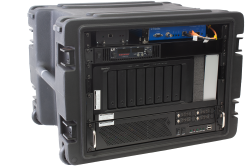
The DASA connects to an included Array
Receiver/Controller (ARC) that manages the array power, receives sensor samples
from array data buses, and computes diagnostic and health monitoring records.
If enabled, the ARC will also run data processing algorithms, record data to
solid-state storage, and/or send data to a remote, connected interface on a
surface buoy or shore.
Segment Linkages
DASA cable segments are connected through
custom low-profile linkages design to be spooled with the array cables during
deployment and recovery. The linkages contain inline data repeaters and
mechanical couplings that are rated to pass the full breaking strength of the
array cable.

Additional Sensors
The DASA sensor bus format supports many
different sensor types that can be included with the acoustic array. The system
can add one or more high-frequency hydrophones (up to 192 kSps). Three-axis
magnetometers can be installed in place of acoustic array channels. The
acoustic channels can be configured over one or more arrays in any geometry.
Systems have been configured with horizontal, vertical, circular, and
orthogonal 3-axis arrays.
Data Processing
The DASA Array Receiver Controller (ARC) runs
a custom Linux operating system on a dual-core ARM Cortex-A9 processor with an
FPGA coprocessor. The ARC software includes functions for array operation,
logging, scheduling, health monitoring, and energy/event detectors. Omnitech
Electronics provides user support and comprehensive interface definitions and
data API’s that users can use to integrate additional functionality and data
processing. Users can use spare processing on the ARC or add a separate coprocessor.
Similar Items
DARU-2330 Digital
Acoustic Recording Unit
1000 m long. 64 hydrophones, bottom-laid,
battery-powered, passive acoustic recording array
DARU-2515 Deep-water
Acoustic Recording Unit
500 m long. 64 hydrophones, deep-water
autonomous recording unit
DASA-2591 Circular
Acoustic Surveillance Array
20 m diameter circular array. 20 low-frequency
and 4 high-frequency, hydrophones
LDHA-2523 Low-power
Digital Hydrophone Array
low power, 48 hydrophones, shallow water
acoustic array
PASS-2447 Passive
Acoustic Surveillance System
multi-aperture, 64 hydrophones,
shore-connected acoustic array
TURNS-2387 Transportable
Underwater Range for Naval Signatures
Portable magnetic signature measurement system
Omnitech Electronics designs innovative
solutions for a multitude of commercial, industrial and government clients.
Omnitech Electronics measures our success by the number of satisfied repeat
customers.
Our core business is the design and
manufacture of advanced custom electronics and solutions for challenging
applications.
Company
Omnitech Electronics at 10 Akerley Blvd, Suite 1 Dartmouth, [Nova Scotia ] NS, Canada, B3B 1J4
-----------------------------------
No comments:
Post a Comment