December 11, 2025

Colby AUKUS Review: Australian Undertakings

As I predicted on June 12, 2025 the overt public "results” of Elbridge Colby’s AUKUS Submarine Review are so ambiguous as to be non-existent. The America First transactional approach has been maintained.

Hegseth, Rubio, Marles and Wong, who met last week to discuss the issue, waited until the end of year to avoid Australian public scrutiny. The "results" were apparently “full steam ahead” from all four pollies. 

My moles advise that the hidden results of the AUKUS Submarine Review are chiefly, Australia resolves:

  • to gift the US A$2.5 Billion per year from 2026 until the 2040s, ie. until Australia has acquired 3 Virginia SSNs. The purchase price per Virginia, spares and training, etc, are extra, and
  • to adhere to US strategic directions and chain of command regarding the tasking of US Virginias delivered to Australia.

The fact that Australia’s part-time Defence Minister, Richard Marles, chooses to keep the AUKUS Submarine Review secret speaks volumes. Clearly Marles’ act hides his embarrassment.

However, as a special service to readers, I draw attention to my article 3rd Priority AUKUS Virginias for Australia: Columbias Top Priority... of December 2, 2025 at https://gentleseas.blogspot.com/2025/12/3rd-priority-aukus-virginias-for.htmlWhich explains:

"In Australia many Australian civilian and naval interests are relying on AUKUS Pillar 1 submarine program keeping to the US deliver a Second-Hand Virginia to Australia by 2032 schedule.

However, it is more likely the first Virginia for Australia will be in 2046 due to the calculations below on the delayed, higher priority, Columbia-class SSBN program which shares supply chains, shipyards and work forces with the third priority Virginia program."

So the Australian Submarine Agency is worried by the prospect of a multi-$Billion Virginia non-delivery embarrassment to become apparent in the early 2030s. Marles, the very model of a modern major politician, will have moved from his part-time defence responsibility to higher, better paid pastures.
December 9, 2025

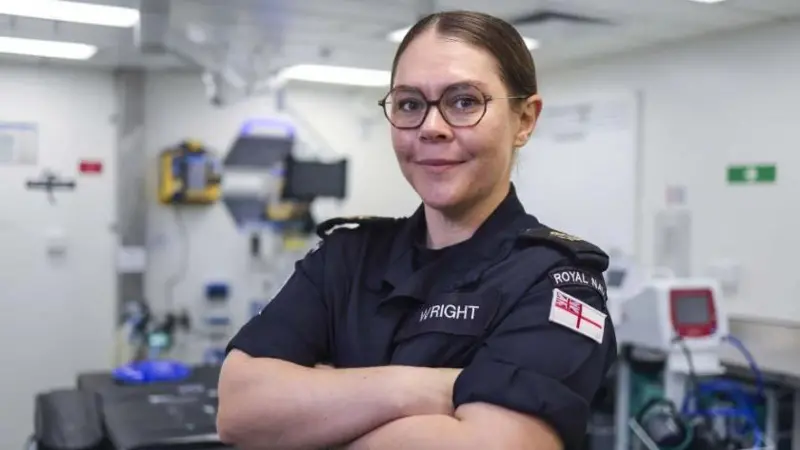
Submarine Mental Health Nurse in UK Royal Navy

Greig Watson in Nottingham for the BBC on December 7, 2025 reported, at https://www.bbc.com/news/articles/cn981qn7pnyo.amp :

"Submarine mental health nurse is 'Woman of Year'"


Leading naval nurse Abigail Wright said periods of isolation presented unique mental health challenges.

A service woman who is the sole dedicated mental health nurse assigned to the Submarine Service has been named "Woman of the Year".

Leading naval nurse Abigail Wright, 33, from Nottingham, said one of her main challenges is to help crews deal with repeated changes of location and colleagues, as well as being isolated from friends and family for months. [SSNs may patrol for 3 months. Then SSBNs for even longer - being out of contact for most of that time.]

She also organised the first International Women's Day at Faslane, the Scottish submarine headquarters where she is based.

Ms Wright has now been named "Woman of the Year" at the 2025 Women in Defence Awards for her work.

Ms Wright, a trained mental health nurse, joined the Navy in September 2020 where she worked at hospitals in Portsmouth, supported Royal Marines training in Norway, and then went to Faslane.

Working with the 5,000 members of the Submarine Service, Ms Wright has undergone specialist training to allow her to go on shorter trips with the vessels, to better to understand crews' experience.

She said she helped crews deal with "adjustment reaction" which was seen widely in the military.

"We are constantly adjusting, whether that be changing where we work, where we live, the people around us.

"But particularly with submarines; you are under the water, there is no daylight, your fresh food runs out pretty quickly.

"There's little contact with home, just one-way transmissions called familygrams which are just as long as a tweet, for 100, maybe 200 days," Ms Wright said.

Ms Wright was - remotely - presented with her award by Rear Admiral Jude Terry

And when boats return, Ms Wright has ensured submariners receive the support needed to reintegrate into everyday life.

She has also worked to make the role of women - who make up only 10% of the Royal Navy and 6% of the Submarine Service - as productive as possible.

"A lot of my work in Faslane, in my spare time, was to improve the experience of women.

"It's so important as we face challenges that perhaps men don't.

"It's important we continue to push those policies and changes to make it as comfortable as possible for women otherwise the recruitment and retention won't improve," she said.

Ms Wright said she was on "cloud nine" after being told about her award - a ceremony she had to attend remotely as she was on HMS Prince of Wales.

"One of my friends who was with me caught my reaction on video and it is pure shock.

"Rear Admiral Jude Terry was the first [RN] woman to reach that rank, so it was extra special to get it from her," she said.

[The RN further reports https://www.royalnavy.mod.uk/news/2025/november/26/20251126-woman-of-the-year : Abigail Wright holds a degree in Psychology and Masters in Nursing. Abigail has been assigned to the medical team on HMS Prince of Wales since August 2025. In 2026 she'll be promoted to Petty Officer and will move to Plymouth to use her expertise working in the Department for Community Mental Health.]

December 2, 2025

3rd Priority AUKUS Virginias for Australia: Columbias Top Priority: Ford Carriers 2nd Priority

In Australia many Australian civilian and naval interests are relying on AUKUS Pillar 1 submarine program keeping to the US deliver a Second-Hand Virginia to Australia by 2032 schedule.

However, it is more likely the first Virginia for Australia will be in 2046 due to the calculations below on the delayed, higher priority, Columbia-class SSBN program which shares supply chains, shipyards and work forces with the third priority Virginia program.

The production of 1.1 “standard” Virginias per year is likely to reduce to 0.8 Block Vs per year (ie. one every 15 months) starting with the Block V USS Oklahoma's expected commissioning in 2030-31 https://en.wikipedia.org/wiki/Virginia-class_submarine#Boats_in_class .

There is also competition from the second prioritydelayed - Ford-class carrier construction program at HII's submarine/shipyard complex in thee state of Virginia

The measuring stick of "deliveries" of Columbias doesn't mean actual commissioning of Columbias. First of class (Columbia) may experience 3 years of pre-commissioning tests (and bug fixing) after delivery to the USN.

In early 2025 USN Rear Adm. Todd Weeks, Program Executive Officer for Strategic Submarines advised the 12 Columbia class delivery or commissioning(?) is to be:

USS Columbia (SSBN-826) in 2029

USS Wisconsin (SSBN-827) in 2032

USS Groton (SSBN-828) in 2034

From USS Grotton Columbia-class delivery will optimistically be one SSBN per year, hence 
SSBN-829 in 2035.

The one SSBN per year drumbeat will mean 
less than one standard Virginia delivered per year. So then to the rest of the Columbias:

SSBN-830   2036

SSBN-831   2037

SSBN-832   2038

SSBN-833   2039

SSBN-834   2040

SSBN-835   2041

SSBN-836   2042

SSBN-837   2043

It is only after the top priority Columbias are completed that (from 2044) a few years of 2 to 3 Virginias constructed per year may permit one used Virginia to Australia in 2046.

More details: “Navy Columbia (SSBN-826) Class Ballistic Missile Submarine Program: Background and Issues for Congress: Updated September 25, 2025 Congressional Research Service https://crsreports.congress.gov CRN R41129 https://www.documentcloud.org/documents/26173199-columbiaprogramcrs/

So the first Virginia Australia is likely to receive is one Very second-hand one in 2046. 

The UK’s SSN-AUKUS development schedule is likely even more delayed given the UKs chronic problems with the PWR2 reactor and piping corrosion and how to avoid this in a miniaturised PWR3 for SSN-AUKUS. 

https://en.wikipedia.org/wiki/Rolls-Royce_PWR#PWR2

December 1, 2025

Canada's Future Subs: VLS Irrelevant? Last 6 Nuclear?: Part One

With its trouble prone Victoria-class submarines expected to retire in the mid to late 2030s Canada is seeking from 8 to 12 new (foreign?) build replacements quite quickly to patrol Canada's 3 oceans (Pacific, Arctic and Atlantic). For this Canada appears prepared to eventually pay up to 60 billion Canadian dollars (about US$43.5 Billion). 

Set out below note the following 15 draft high-level mandatory requirements "Patrol Submarine Project – Request for Information | Solicitation ID W8481-23PPS | RFI – Annex A – Draft HLMRs (Report). Government of Canada. June 12 2023, [5] recorded here https://en.wikipedia.org/wiki/Canadian_Patrol_Submarine#Background :

  • "The platform shall be a submarine that can perform patrol and surveillance missions in Canada’s maritime approaches and littoral waters.
  • The platform shall be conventionally powered (diesel-electric).
  • The platform shall have an operational range of at least 7,000 nautical miles (13,000 km; 8,100 mi) on diesel fuel at 8 knots.
  • The platform shall be able to transit at least 3,000 nautical miles (5,600 km; 3,500 mi) submerged on batteries/AIP before snorting.
  • The platform shall be able to operate in first-year Arctic ice (up to 1 m thick) and survive in polar-class cold-weather conditions.
  • The platform shall have a low acoustic signature consistent with modern SSK design standards (radiated noise ≤ 110 dB/1 µPa/√Hz re 1 Hz at 1 kHz).
  • The platform shall be fitted with a bow sonar array, flank arrays, and a towed array sonar.
  • The platform shall have at least six 533 mm torpedo tubes and be able to store and launch torpedoes, missiles, mines and UUVs. [Note no requirement for VLS]
  • The platform shall provide secure VLF/HF/UHF and SATCOM communications with Canadian and allied networks.
  • The platform shall be fully interoperable with NATO and Five-Eyes submarine rescue and C4ISR standards.
  • The platform shall meet survivability criteria for shock, fire, flooding and chemical-biological-radiological threats.
  • The platform shall accommodate a mixed-gender crew of at least 60 personnel for deployments up to 60 days without resupply.
  • The platform shall be designed for through-life support in Canada, including training simulators and Canadian-sourced spare parts.
  • The platform shall deliver minimum 25 % Canadian content by value over the total programme life.
  • The platform shall be certified to Transport Canada/RMRS safety rules and be upgradeable through at least two mid-life modernisations."

Pete Comment/Background

On August 26, 2025 Canada shortlisted Germany's TKMS Type 212CD (Common Design) and South Korea's Hanwha Ocean's KSS-III to develop paper designs by 2028 that are variants of operating subs for what is called the Canadian Patrol Submarine Project (CPSP).

Notwithstanding KSS-IIIs for the South Korean Navy featuring vertical launch systems (VLS) there appears no VLS (in the above requirements) for Canada's future submarines. In fact Canada's Victoria-class do not carry Harpoon missiles (see right sidebar) let alone Tomahawks. South Korea offered India a "DSME-3000" KSS-III variant without VLS.

So the KSS-III's proven VLS capability may be no advantage in the Canadian competition. Canada may perhaps buy 6 non-VLS KSS-IIIs initially. This may be  followed eventually by 6 South Korean built nuclear powered submarines, excellent for under-ice work, bears consideration. The cost of nuclear powered submarines and quicker build factor may not be prohibitive (for Canadian and Australian customers) if South Korea builds them. Australia might also get around the looming 20-25 years non-delivery of AUKUS SSNs crisis.