.jpg/1920px-CNO_Adm._Lisa_Franchetti_speaks_in_front_of_Boeing%E2%80%99s_Orca_Extra_Large_Unmanned_Undersea_Vehicle_(cropped).jpg)
Boeing's Orca above possibly 16m standard length (Photo courtesy US Navy) and below showing around a 2m beam (Photo courtesy MilitaryLeak(dot)com).
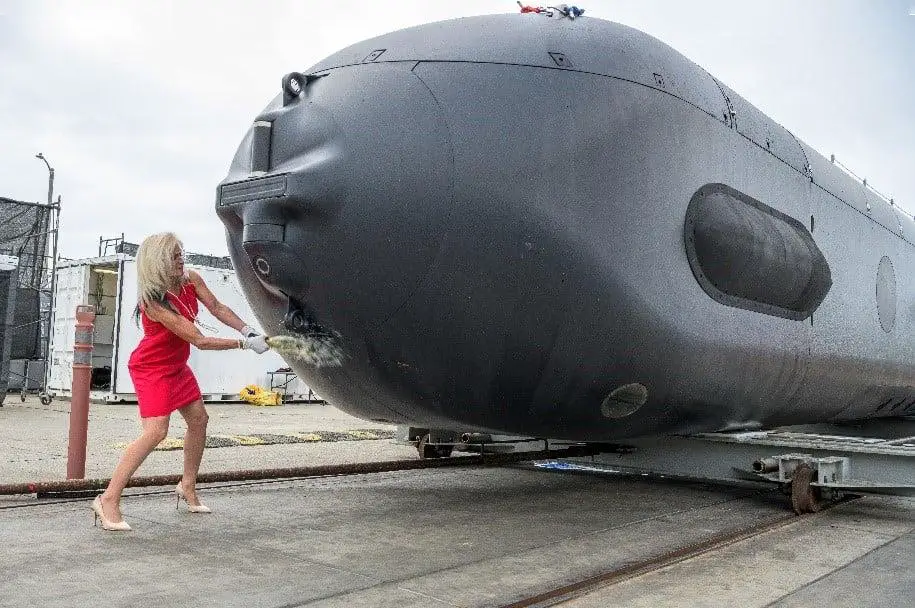
As with nuclear
armed US SLBMs since the 1960s the promise of
Mutually Assured Destruction (MAD) ie. a nuclear deterrent, may be the best defence against Russia's
Poseidon nuclear armed, nuclear powered torpedos/AUVs. https://en.wikipedia.org/wiki/Status-6_Oceanic_Multipurpose_System
If Russia even hinted that it might use Poseidons against the US, the US could promise it would launch US Poseidons and other nuclear weapons against
Russia.
When the US put out tenders for the Orca very large UUV/AUV, Boeing publicly won the competition https://en.wikipedia.org/wiki/Orca_(AUV). But significantly there was no word or complaint, I know of, from the other competitor, Lockheed Martin (LM), about losing. I suspect LM was asked to develop "black program" US nuclear armed, nuclear propelled Poseidon-like weapons as a response to Russia and also for potential use against China, North Korea and any other hostile nuclear powers.
The US quietly telling Russia "we also have a Poseidon we could use against you" constitutes the age-old and effective MAD strategy. Boeing may also be in the know about this LM project because LM could use Boeing's Orca "hull" conveniently larger (up to 26m long = 16m standard + 10m payload module) than Russia's 20m Poseidon (see right sidebar).
Russia has not been innovative.
ReplyDeleteThe 9M730 Burevestnik nuclear powered cruise missile is a concept the US was developing from 1955 to 1964, with the SLAM concept.
https://en.wikipedia.org/wiki/Supersonic_Low_Altitude_Missile
Status-6 is a big and noisy weapon (when in high speed mode) and the Russians do not have a global underwater communication system, so the weapon would need to pop up a sensor for commuincation.
Like the majority of Russia's military status projects, plenty of noise, little substance.
I agree. Ukraine fighting has already proven that leading western SAM systems can shoot down much smaller and faster Russian IRBMs. Surely they could shoot down Burevestnik as well?
DeleteLikewise Poseidon. This sounds more like a psy-ops terror weapon than a serious capability. All NATO navies could track it from many kms away. As it gets near a target port it would have to come up to shallower water, at which point it could be intercepted. Slow, silent long range underwater drones (UUVs) seem a much greater threat.
Indeed the Burevestnik and Poseidon seem modern iterations of Hitler's failed wonder weapons.
ReplyDeleteThey aren’t wunder waffe, they are status weapons.
ReplyDeleteIts like the Sukhoi S-70 Okhotnik-B prototype that went rouge and the Russians had to shoot it down over Ukraine.. pretty sure the Ukrainians sold the wreckage analysis to anyone in the West.
Hi Shawn at 11/20/2025 5:34 PM
ReplyDeleteI imagine Western countries would factor in Ukrainian transfers of Russian technology and of Russian tactical performance data when Western countries donate arms and funds to Ukraine.
Yet like Ukraine in WW2 (from the Germans) the lasting damage (from Russian aggression) to Ukraine would be immense.
The scenario of a US need to chase Poseidons travelling at 100 knots may be myth when the US has so many oceanic and coastal acoustic sensors that would "see" Poseidons and track Russian parent submarines.
ReplyDeleteSuch sensors could interact with US conventional and nuclear armed torpedoes deployed in front of Poseidons to intercept and destroy Poseidons and Russian parent submarines.
US NUCLEAR ARMED TORPEDO
ReplyDeleteFrom https://en.wikipedia.org/wiki/Mark_45_torpedo
The Mark 45 anti-submarine torpedo (ASTOR) was a submarine-launched wire-guided nuclear torpedo designed by the United States Navy for use against high-speed, deep-diving, enemy submarines. This was one of several weapons recommended for implementation by Project Nobska, a 1956 summer study on submarine warfare.[5]
The 19-inch (483 mm) torpedo was fitted with a W34 nuclear warhead. The need to maintain direct control over the warhead meant that a wire connection had to be maintained between the torpedo and submarine until detonation. Wire guidance systems were piggybacked onto this cable, and the torpedo had no homing capability. The design was completed in 1957,[3] and 600 torpedoes were built before 1976, whereupon ASTOR was replaced by the Mark 48 torpedo."